

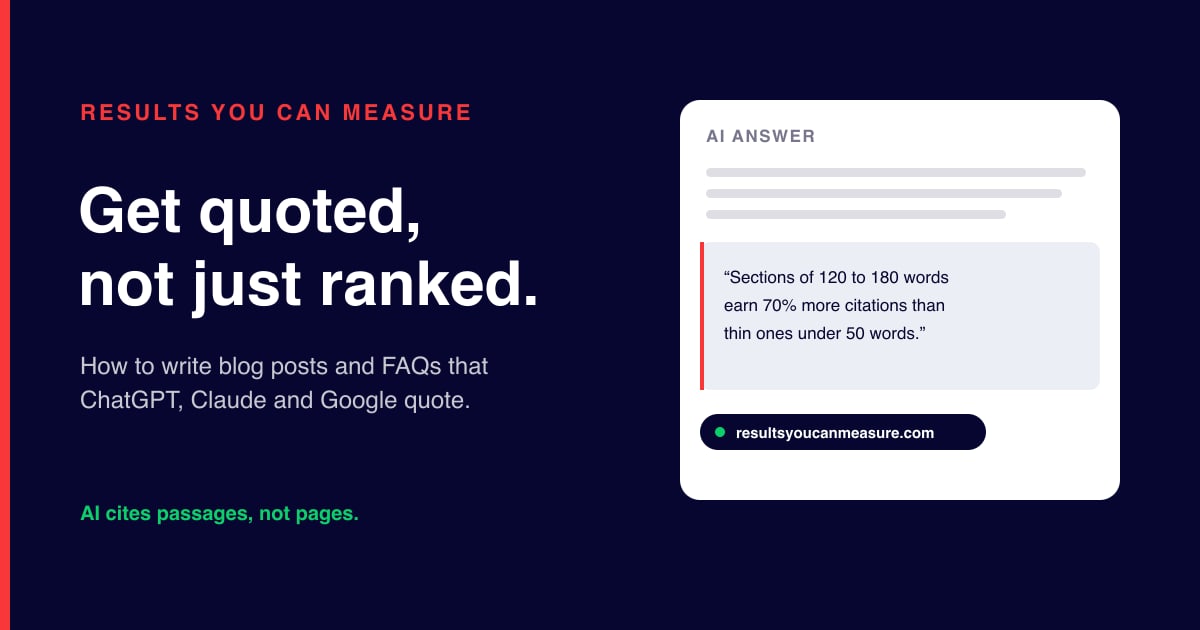
AI assistants do not cite pages. They cite passages. ChatGPT, Claude, Perplexity and Google AI Overviews break a page into chunks, retrieve the chunk that best answers the question they were asked, and quote it. So the thing you are really writing is not the article. It is the passage, and every passage has to survive being torn out of the page and shown on its own.
That single mechanic changes how you open a piece, how long your sections are, and how you phrase a claim. The useful part is that the highest-impact changes are editorial rather than technical. They are things a writer can do today, in the copy, without touching the build.
TL;DR: AI engines quote passages, not pages. Answer the question in the first 50 words, break the body into self-contained 120 to 180 word sections under question-shaped headings, and back every claim with a specific number and a named source. Then check the two technical gates: your text must exist in the raw HTML, and your robots.txt must let the AI crawlers in. Miss either gate and none of the writing matters.
What actually makes AI quote your content?
This is not guesswork. Researchers at Princeton, Georgia Tech, the Allen Institute and IIT Delhi ran the first controlled experiment on it, published as GEO: Generative Engine Optimization at ACM SIGKDD 2024. They tested nine different content changes across a benchmark of around 10,000 queries and measured which ones moved visibility in AI answers.
Three changes did most of the work:
- Adding quotations from named authorities, verbatim and attributed.
- Citing sources so every key claim is traceable to something checkable.
- Adding statistics in place of vague quantifiers.
Together these lifted visibility by up to 40%. One tactic actively backfired: keyword stuffing reduced visibility. The old habit of repeating a phrase until it ranks does not just fail here, it costs you.
How should a blog post be structured for AI search?
Lead with the answer. A study by ALM Corp found that 44% of ChatGPT citations come from the first third of a page. A post that spends three paragraphs setting the scene gives the extractor nothing to grab.
The pattern that works is simple: direct answer, then the one number that proves it, then the nuance.
Here is the difference in practice. A page that opens “When businesses start thinking about customer relationship management, there are many factors to weigh” is unquotable. A page that opens “CRM software typically costs between £12 and £150 per user per month, with most small business plans landing around £25 to £50” can be lifted whole and still make sense.
Read your own opening paragraph on its own, with no page around it. If it does not answer the question in the title, rewrite it.
How long should each section be?
Between 120 and 180 words. SE Ranking’s citation research found that pages with sections of 120 to 180 words between headings earned 70% more ChatGPT citations than pages built from thin sections under 50 words.
That band exists for a reason. It is long enough to carry a complete answer plus the fact that supports it, and short enough for a model to parse and attribute cleanly. Anything under 50 words is a stub, too thin to quote, so it never gets quoted. Anything over about 400 words is a wall the engine has to guess its way through.
Four rules keep each section quotable:
- One idea per section. Never braid two topics into one block of text.
- Repeat the name inside the section. Write “Results You Can Measure recommends”, not “we recommend”. The engine may lift the passage away from the sentence that defined “we”.
- Write headings as questions. “How much does it cost?” beats “Pricing”. Match the way a person actually asks.
- Expand your stubs. A 30 word answer needs a supporting number and a source to reach the band.
One more finding worth acting on: pages containing comparison tables earn around 2.5 times more citations than text-only equivalents.
How do you cover the questions you were not asked?
Modern engines decompose a prompt before they answer it. Google’s AI Mode fires roughly 8 to 12 sub-queries per prompt and ChatGPT fires between 4 and 20. Your page is competing for those sub-queries, not just the headline one.
This is the single biggest lever in the data. ALM Corp analysed over 173,000 URLs and 33,000 fan-out queries and found that pages ranking for the sub-queries were 161% more likely to earn an AI Overview citation than pages ranking only for the main keyword, with a strong correlation between the two (Spearman 0.77).
Finding the sub-questions is straightforward. Ask an AI assistant your headline question and note the follow-ups it offers. Or simply list the natural variants: what is it, why does it matter, how does it work, how much, when, versus the alternative, is it worth it. Each one that fits the piece becomes its own headed section. Each one too big to fit becomes its own page, linked back to this one.
How do you write an FAQ that gets quoted?
A well-written FAQ is the most citable format there is. The question is already phrased the way a person asks it, and the answer is already self-contained. Most business FAQs waste that advantage by being too short and too vague.
Six rules turn an FAQ into a citation unit:
- Ask the question the way a customer types it. “How much does an emergency call-out cost?” not “Call-out charges”. Use their words, including the ones you would rather they did not use.
- Answer outright in the first sentence. No “it depends”, no “great question”. If it genuinely does depend, say what it depends on and give the range, in that first sentence.
- Then expand to 120 to 180 words. Add the supporting number, the exception and the source. A 25 word answer is not quotable.
- Name the business inside the answer. Every entry gets read in isolation, so “Results You Can Measure charges” beats “we charge”.
- One question per entry. Never answer three things in one block.
- Never duplicate an answer across pages. Two pages answering the same question in near-identical words split your own citation odds and read as thin content.
Compare “Yes, we support SSO on our higher plans, contact us for details” with a version that names the plan, the price, the setup time and who typically needs it. Only one of those is worth quoting.
Does FAQ schema still do anything?
Yes, but not what most people think, and anyone still selling you FAQ rich snippets is selling something that no longer exists. Google removed FAQ rich results on 7 May 2026, with reporting disappearing from Search Console in June 2026 and API support ending in August.
Keep the FAQPage markup anyway. It remains valid Schema.org, and its value now is that it labels clean question-and-answer pairs in a form machines parse without ambiguity. Just be clear that the payoff is machine readability, not extra space in the search results.
There is also no special schema for AI features. Google’s own documentation states that no bespoke markup or machine-readable file is needed for AI Overviews or AI Mode. The markup that still earns rich results is the ordinary set: Organization, LocalBusiness, Article, Product, Review, Video and BreadcrumbList.
Why do some perfectly good pages never get cited?
Because of two technical gates that sit underneath all of the writing. If either one fails, nothing above matters. This is the part that belongs to whoever builds your site, and it is worth checking before you commission a single word.
Gate one: your text must exist before JavaScript runs
Most AI crawlers do not run JavaScript at all. Vercel’s Rise of the AI Crawler study, based on real crawler traffic, concluded that “none of the major AI crawlers currently render JavaScript”. GPTBot fetched JavaScript files in around 11.5% of its requests and ClaudeBot in around 23.8%, and neither ever executed them. They make one request, read whatever HTML comes back, and move on.
If your content is injected client-side, which is common on app-style sites built with React or Vue, every AI engine except Google receives an empty shell. Google’s Gemini is the exception because it reuses Googlebot’s render service.
To check: run your page through a plain HTML fetch and search the result for a distinctive sentence. If a browser shows it and the raw HTML does not, you are invisible to AI search. This site is statically rendered for exactly this reason, which is the same decision that produced the results in our website speed guide.
Gate two: the crawlers must be allowed in
A perfect page never gets cited if the crawler is turned away at the door. Since 1 July 2025 Cloudflare has blocked AI crawlers by default on new domains, so a great many sites are blocking the exact bots they want citations from and have no idea it is happening.
Read your own robots.txt and confirm that OAI-SearchBot, PerplexityBot, ClaudeBot, Claude-SearchBot, Google-Extended and Bingbot are allowed. Then check your CDN separately, because a site can allow them in robots.txt and still block them at the edge. The two settings are independent and only one of them is visible to you.
What should you not do?
Several popular tactics are counterproductive, and two are explicitly named by Google.
- Do not chop content into fragments aimed at models. Google’s January 2026 guidance warned specifically against this. Structure for extractability, but it must still read naturally to a person.
- Do not keyword stuff. The Princeton study measured it. It reduced visibility rather than improving it.
- Do not publish at volume. Google’s June 2026 spam update targeted scaled content abuse, and publishing velocity is itself a signal now. Every page should pass one test: would this page exist if search traffic did not?
- Do not bump the date without changing anything. Freshness matters more in AI answers than in classic ranking, but only for genuine edits. A touched timestamp is a recognised spam signal.
- Do not answer in 30 words. This is the most common failure in real business FAQs. Too thin to lift, so never lifted.
How do you know if it is working?
Rank tracking will not show you this. Citation visibility is measured by asking the engines and counting, so set a baseline before the work starts and re-check on a fixed cadence.
- Build a prompt library of 20 to 40 questions a real buyer would ask an assistant in your category.
- Run them across ChatGPT, Claude, Perplexity and Google AI Mode. Record whether you are mentioned, whether you are cited with a link, and which competitors appear instead.
- Track share of voice across the whole prompt set rather than any single answer. Answers vary between runs, so one result proves nothing.
- Check your server logs for AI crawler hits. If GPTBot and ClaudeBot are not fetching the page, no amount of rewriting will help.
- Allow two to four weeks after publishing before judging a rewrite.
Related services
- SEO for search and AI visibility built on the same foundations
- Copywriting for content written to be quoted, not just read
- Web Development for sites that pass the rendering gate by default
FAQs
Is AI search optimisation different from SEO?
It layers on top of SEO rather than replacing it. The foundations are shared: crawlable pages, clear structure, genuine expertise and fast loading. What changes is the unit of optimisation. Classic SEO optimises a page to rank as a link. AI search optimises a passage to be lifted and quoted inside an answer. A page can rank well and still never be cited, usually because the answer is buried, the sections are too thin, or the content is not in the raw HTML.
How long should a page be to get cited by AI?
Long enough to answer the sub-questions properly, which in practice means around 1,900 words or more for a substantial guide. Length alone does nothing. What matters is that the page is built from self-contained sections of 120 to 180 words, each answering one question completely. A 3,000 word page written as one continuous argument will be cited less than a 1,200 word page broken into clean, answerable blocks.
Do I need to block or allow AI crawlers?
Allow them if you want to be cited, because a blocked crawler cannot quote you. The trade-off is real: allowing crawlers means your content trains and informs AI answers without a click. Most small and medium businesses gain more from being named in the answer than they lose in traffic, because the alternative is a competitor being named instead. Check both robots.txt and your CDN settings, since Cloudflare has blocked these bots by default on new domains since July 2025.
How long does it take to show up in AI answers?
Allow two to four weeks after publishing or rewriting before judging the result. The crawlers need to fetch the page and the engines need to index it. If nothing has changed after a month, check the two technical gates first rather than rewriting the copy again. In most cases where a good page is invisible, the cause is rendering or crawler access, not the writing.
Want to be the answer, not just a link?
If your content ranks but never gets quoted, the cause is usually structural and it is fixable. Book a call and we will look at how your pages are built, whether the AI crawlers can reach them, and what it would take to get your business named in the answer.